
Historical publications Centuries XVI - XX
The publications found in this section have been digitalised from the original documents, providing access to INE's considerable historical collection, which was previously only available at INE's library in printed format or microfiche.
INEbase History
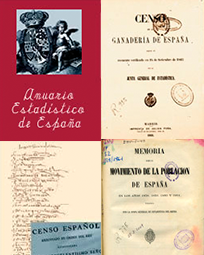
An application designed for navigating throughout the publication using a hierarchical index, similar to that found in the original publication, that allows users to reach the table containing the desired information, which will be downloaded when selected. A search tool based on the titles and contents of the tables allows users to search for the information in a more efficient manner.
Yearbooks, 19th-20th century Censuses and 19th-20th century Vital Estatistics
Complete publications
Files in PDF format containing the publication in full.
These publications are also available for sale in paper format, through this link you can check their price and how to purchase them.
-
Commoners Census 1528

This Work, divided into two volumes, is a summary transcription and prepared from documents which comprised file 768 of the General of the Simancas General Archive. This covers the review that Emperor Charles I ordered be carried out on commoners registries, that is, the residents obliged to pay taxes to His Majesty, these being taxes approved by the Court, from which the Nobility and the Church were exempt. This established a village by village examination of the number of commoners and the amount they paid will be recalculated to take into account their number and the wealth of each place and to ensure equal distribution of royalties or the contributions from each village.
Compilation took almost eight years, but the data refer to payments made in the years 1527 and 1528. April 2008
Publication date: April 2008
-
Census of the Crown of Castile 1591
 NIPO 729 16 005 9 NIPO 065 17 016 6
The Population Census of the provinces and districts of the Crown of Castile, or Censo de los Millones, was conducted in 1591 with the aim of collecting eight million ducats through an extraordinary tax. They are presented in four volumes with the following contents:
- Facsimile (includes commentary), reproducing the Census. The work was carried out by the canonical archivist of Simancas, Tomás González Hernández, and is a veritable oeuvre of statistical-historical research.
- Analytical Study, which includes an extensive study of the Census, extracting the most complex data and hidden information that reality obscures. In this work, history and statistics come together to provide scholars specialising in the 16th century with an overview and tools that will make their task easier and more comprehensive.
- Vecindarios, presents a revised transcription, corrected and accompanied by an extensive series of notes expressing all the incidences or internal inconsistencies of the Census of the Crown of Castile of 1591 or Censo de los Millones. It is complemented by the commentary of Molinié-Bertrand, the French hispanist whose research made it possible to find the current names of the approximately 12,000 entities included in the Census.
- Annex to Vecindarios, contains alphabetical indexes of localities, deviations and misprints.
Publication date: March 2018
-
Salt Census 1631
 NIPO 729-14-022-7
The 1631 Salt Census was conducted under the reign of Philip IV. It is a result of the establishment of a new salt taxation system, salt being an essential item whose monopoly belonged to the Crown. Its scope covered the mainland territories of the Crown of Castile.
The work consists of two volumes:
Volume I. Neighbourhood: this includes the statistical tables for each one of the salt-producing parties included in the transcription, to which the current names of the places and their corresponding INE codes have been added.
The information is completed with an explanatory comment for the Neighbourhood, different índices, census terminology, sources and bibliography, as well as an annex with maps and salt maps.
Volume II. Transcription: the INE has carried out the transcription of the document, using the original manuscript preserved at the General Archive of Simancas.
February 2015
-
Vecindarios 1646
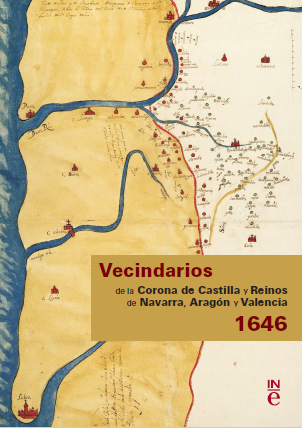 NIPO 096-21-004-5
The Vecindarios, which are akin to municipalities, were the surveys conducted between 1646 and 1647 that fulfilled the agreements made with the courts of the different kingdoms with the aim of providing and distributing resources among the vecinos, important persons subject to taxation, in view of the pressing financial and military needs of Philip IV. This publication is a compilation of previously unpublished quantitative data on places and vecindad of the Crown of Castile and, for the first time, other peninsular territories of the Hispanic Monarchy, such as the kingdoms of Navarre, Aragon and Valencia.
Publication date: October 2021
-
Campoflorido Census 1712
 NIPO 729 16 003 8
The Censo de Campoflorido was conducted in 1712 by mandate of the Royal Councillor of the Treasury for a fairer distribution of taxes due to the War of the Spanish Succession. Five years later, the Marquis of Campoflorido ordered it to be contained within his Secretariat of Finance. This is the origin of its name and the erroneous dating of 1717.
It was the first census to cover the whole of Spain and, together with other documents on the population at the time, it formed a dossier called Vecindario General de España, 1717, which is reproduced in the publication.
Publication date: December 2016
-
Livestock Census of the Crown of Castile 1752
 NIPO 729 16 007 X
The Censo Ganadero de la Corona de Castilla 1752 contains the transcription of the contents of Books H of the Estados Generales or Resúmenes, the general accounts issued by the Junta de la Única Contribución (commission for a single tax) with the data compiled to form the large-scale census known as the Catastro de la Ensenada. Volume I contains the livestock belonging to laymen Volume II to ecclesiastics. In addition, the necessary elements have been introduced for a quick juxtaposition of data, if preferring to unify them in relation to a certain locality. It should be borne in mind that the livestock listed is not the number of animals owned by all the inhabitants of each village, rather the animals which are the object of livestock farming; neither does it include "corral" (poultry and rabbit farming).
Publication date: December 2016
-
Population Census of the Crown of Castile. Marqués de la Ensenada. 1752
-
NIPO 729 16 006 4
The Population Census of the Crown of Castile or Censo del Marqués de la Ensenada was conducted in 1752. The oeuvre was planned in four volumes; I and III contain classifications of the population made by the Contadurías Principales de las Intendencias and can be considered as the Censo de Población del Marqués de la Ensenada proper, while volumes II and IV are contributions of the INE to facilitate the handling and understanding of the work.
- Volume I Manuscripts: contains the list of towns, inhabitants and buildings of each province.
- Volume II Nomenclatures: contains the gazetteer of the villages listed in the Census.
- Volume III Menestrables (Volume A, Volume B), deals with people who exercised a manual trade, such as artisans and all those whose economy depended on unskilled physical labour. Known as menestrales, they formed the main part of the great mass of pecheros, or commoners.
- Volume IV Cartography: includes maps of the 22 intendencias, the administrative authorities that comprise the Census.
Publication date: December 2016
-
Count of Aranda Census 1768

Count of Aranda Census is considered to be the first modern census to be conducted in Europe. The genuine history of the Spanish population censuses begins in 1768, when the Count of Aranda gave specific orders to commence tasks aimed at establishing the "genuine population of this Monarchy" so as to promote useful ideas to the State, in terms of the sex and age of the population.
The execution of the Census ordered by the Count of Aranda was commissioned to the bishops who were given appropriate instructions to, through the parish priests of their different dioceses, collect the information required on the different locations in the areas in compliance with a single form.
In order to better study the data, the INE has reclassified information on villages, at source sorted by parish, sorting it in accordance with the current provincial partitioning, completing the statistical tables with current cartography. August 2013
- Book I. Dioceses of Albarracín, Astorga, Ávila, Badajoz, Barbastro and Barcelona. Order Santiago: Llerena. Order of Alcántara: Magacela.
- Book II. Dioceses of Burgos and Cádiz.
- Book III. Dioceses of Calahorra, Canarias, Cartagena, Ceuta, Ciudad Rodrigo, Córdoba, Coria, Cuenca. Vicaría: Benamejí.
- Book IV. Dioceses of Gerona, Granada, Guadix, Huesca, Jaca and Jaén. Abadía Alcalá la Real.
- Book V. Dioceses of León, Lérida and Lugo.
- Book VI. Dioceses of Málaga, Mallorca, Mondoñedo, Orihuela and Osma.
- Book VII. Dioceses of Orense, Oviedo, Palencia, and Pamplona.
- Book VIII. Dioceses of Plasencia, Salamanca and Santander.
- Book IX. Dioceses of Santiago, Segorbe and Segovia.
- Book X. Dioceses of Sevilla, Tarazona, Teruel, Toledo and Tuy.
- Book XI. Dioceses of Valencia, Valladolid, Zamora and Zaragoza.
-
Floridablanca Census 1787
 NIPO 065 17 017 1 NIPO 065 17 015 0
The Censo de Floridablanca, conducted in 1787 under the direction of the Count of Floridablanca, had a primarily demographic and economic purpose, rather than fiscal. It is one of the first censuses carried out using modern statistical techniques:
- The information is collected by individuals and not by vecinos and its objective is not only to determine the number of inhabitants but also their characteristics: sex, profession, age and marital status.
- This is done through village visits by the competent authority and it was forbidden to make individual data public.
- Other data is also collected, such as the number of hospitals, houses of religion, prisons, etc.
- A civil division of the territory follows: Provinces and Intendencias of Spain and its islands (including Oran, Ceuta and the minor presidios of Alhucemas and El Peñón)
In this section, the INE publishes a transcription by town, according to the documentation located in the Archive of the Royal Academy of History, the Royal Palace Library, the National Library and other provincial archives. In the work, the villages mentioned are presented by their current and former names, grouped according to today's provinces and these by autonomous communities.
- Book I. Southern Autonomous Communities
- Book II. Southern Sub-plateau Autonomous Communities
- Book III. Northern Sub-plateau Autonomous Communities: Volume 1 and Volume 2
- Book IV. North Atlantic Autonomous Communities
- Book V. Pyrenean Autonomous Communities
- Book VI. Central Mediterranean Autonomous Communities
- Facsimile
- National Historical Congress. The Spanish population in 1787
Publication date: March 2018
-
Godoy Census 1797

NIPO 729 16 004 3The Censo de Godoy is the name given to the Census of the Population of Spain in 1797, carried out by order of the king in 1801.
The publication is a facsimile reproduction of the 1801 edition, which presented the data on the Spanish population by Intendencias or provinces at the time. It follows the same line as the Floridablanca 1787, but with more refined classifications and undertaken with the idea of creating a project of continuity and periodicity that was cut short by the Napoleonic invasion. Its data, although more detailed, are perfectly comparable with those of Floridablanca. It is accompanied by an exhaustive list of the towns that made up each intendencia, applicable to both cases.
Publication date: December 2016
-
Professional Services and Work Income in the villages of Corona de Castilla, midway through the 18th century
 NIPO 065 17 027 3
By means of this publication we can ascertain curious data on people's occupation, the income they obtain with their jobs and personal services they had avail able at their place of residence. The shortcomings it suffered also and how, to remedy them, they had to move to other places under very different circumstances to those current ones.
The publication contains the tables resulting from operation of the so-called F books from the General Ensenada Land Registry States which cover the data from liberal professions from all town councils not assessed from the former Crown of Castille.Unlike the G books, these F books detail the annual income of each profession although without indicating the number of people. March 2018
-
Populations imputed during the first half of the 19th century
 NIPO 065 17 026 8
Publication which presents the works carried out to quantify the population during the first half of the 19th century.
During the years that make up this period, no direct registration census was carried out which was habitual half way through the 18th century. Censuses were replaced by simple population imputations at different levels of local breakdown. Fourteen imputations have been compiled on a provincial scale, four of a judicial nature and one, dated in 1842 on a municipality level. The latter, because of its scope, content and presentation can be considered a population census, as all municipalities appear related and, as of then, all the statistics use the municipality for territorial information. March 2018
-
Spain in light of the 1887 census
 NIPO 1993-04-15
This publication, apart from including statistical tables with sociodemographic indicators from the period and 34 maps, highlights the state of Statistical Science in the 19th century and the context in which the census was carried out in 1887. December 2018